A connecting rod is a matched assembly, not a single part. It has to align a piston pin with a crankshaft journal while carrying the highest alternating load in the engine, and it has to do that at the same weight as the other five rods in the set. Get any of those three wrong and the engine runs — badly — until it does not.
This guide covers the dimensions that decide fitment, how bend and twist are actually checked, why rod bolts are single use, and the assembly steps that prevent a repeat failure.
Each firing event pushes the piston down, and that force passes through the rod into the crankshaft. The big end bearing sees a load that reverses direction twice per revolution, which is why it fails before most other bearings when oil supply or clearance is marginal.
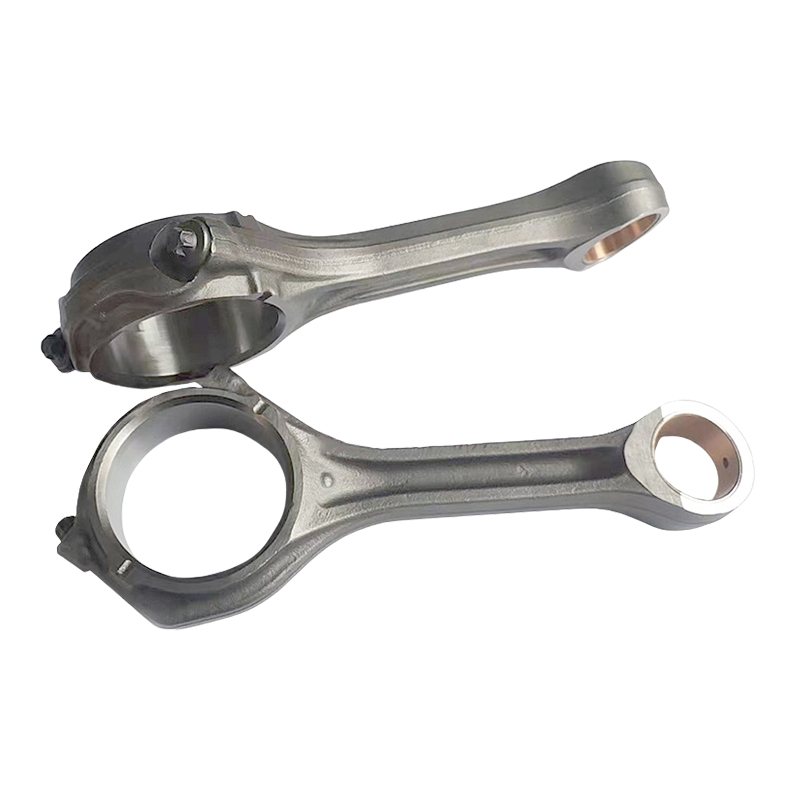
The rod also has to keep the piston square in the bore. A rod that is bent or twisted pulls the piston against one side of the liner, and the result looks like a piston or ring problem rather than a rod problem.
| Dimension | What it must match | If wrong |
| Big end bore | Bearing shell and journal size after any regrind | Excess clearance, low oil pressure, bearing knock |
| Small end bush diameter | Piston pin diameter | Pin seizure or uneven load on the piston |
| Centre-to-centre length | Engine specification | Compression height changes, piston-to-head contact |
| Weight class | The other rods in the set | Vibration misdiagnosed as crankshaft or damper fault |
Measure the big end bore with the cap torqued to specification and the correct shell fitted. Measuring with the cap loose, or without the shell, gives a number that means nothing.
Every rod in a set should be within the manufacturer’s weight tolerance of the others. When you replace fewer than a full set, the new rod has to be matched to the ones staying in the engine.
A mismatch of twenty grams sounds trivial and is not. It produces an unbalanced couple that shows up as a vibration at a specific engine speed, and the usual diagnostic path — damper, crankshaft, flywheel — misses the actual cause because the rod was assumed to be correct.
Ask the supplier for the rod weight before it ships, and weigh it when it arrives.
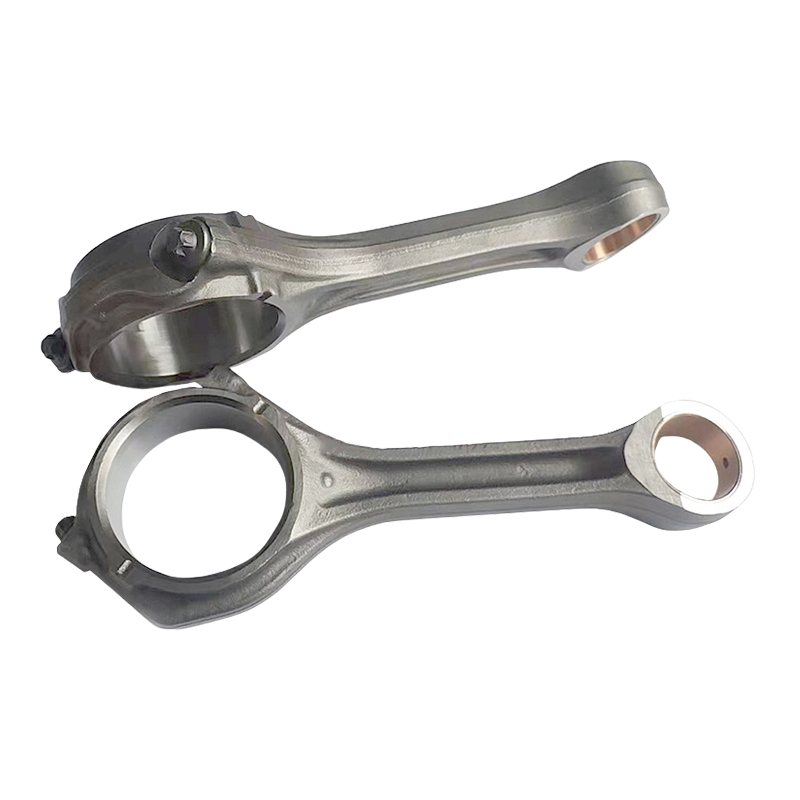
Bend and twist cannot be judged by eye on a used rod. They are measured on a fixture with the big end located by a mandrel and a dial gauge reading against the small end bore, one axis at a time.
What the two readings tell you:
Neither condition can be corrected. A rod that is out of tolerance is replaced, because straightening a forged rod changes its fatigue life and it will fail at the next stress cycle.
Rods on these engines use torque-to-yield bolts. They are tightened past their elastic limit so the clamp load is set by the bolt’s stretch rather than by friction, and once stretched they cannot be reused.
Two failure modes follow from reuse:
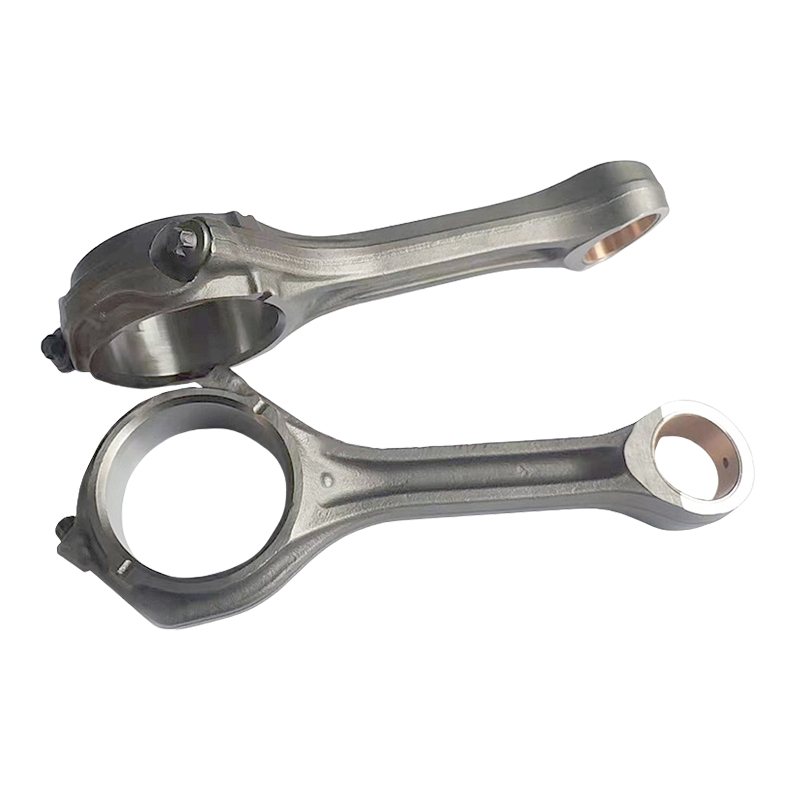
Inspect the cap joint before assembly. A polished or discoloured band on the mating face means it has already moved, and the rod should not go back in.
Big end shells must match the journal size after grinding, not the original size. Fitting standard shells to an undersize journal gives excessive clearance, low oil pressure and a knock that appears within minutes of the first start.
Measure the journal, confirm the shell size against the journal, and check clearance with plastigauge at assembly. Record the figure — it is the only way to know later what was actually built.
| Symptom | Likely cause | Confirmation |
| Knock at a specific speed | Big end clearance or weight mismatch | Plastigauge, rod weights |
| Blue smoke and bore wear on one side | Bent rod | Fixture measurement |
| Ring wear on a diagonal | Twisted rod | Fixture measurement |
| Bearing spun at low hours | Stretched or reused bolts | Bolt history, cap fretting |
| Pin seizure | Small end bush clearance | Bush bore measurement |
No. Straightening a forged rod changes its fatigue life and it will fail again. Replace it.
Only if weight matching or damage requires it. When replacing fewer than a set, have the new rod matched to the others.
No. Big end shells are ordered separately and must match the journal after any regrind.
Oil starvation, incorrect clearance, or a stretched bolt that lost clamp load.
Our connecting rod section lists the assemblies we hold by engine and part number, with the fitment dimensions for each. For specific applications, see the WP6 connecting rod 12160519, the WP7 and WP8 connecting rod 610800030073, the WP9 connecting rod 611600030017, the WP13 connecting rod 612630020017 and the Baudouin 4M10G connecting rod 1004743018 pages.
If the rod number is unreadable, send a photograph of the big end with a ruler alongside plus the engine plate. The big end bore and the weight class usually identify the variant faster than the number does.

